

Your shop spends £20,000 a month on ads: £12,000 on Meta, £8,000 on Google. The dashboards say Google returns 6 and Meta returns 2. The obvious move is to cut Meta and put the money into Google.
Do that and Google usually gets worse too. The platforms do different jobs, so their dashboard numbers cannot be compared side by side.
Google collects, Meta creates
Google collects demand that already exists. Someone types “waterproof trail running shoes UK” and sees your ad. They were ready to buy.
Meta creates demand. Someone scrolling Instagram was not planning to buy running shoes. A good ad makes them want a pair.
What the dashboards leave out
Say these are the figures (an example):
Some people who saw a Meta ad did not click. Days later they searched your brand on Google and bought. Google gets the credit and Meta looks weak.
Cut Meta and fewer people hear about you, so fewer search for your name. Over 4 to 8 weeks Google slips too. You saved the Meta budget and lost sales on both.
That is why platform ROAS can mislead. Judge the pair on total sales against total spend.
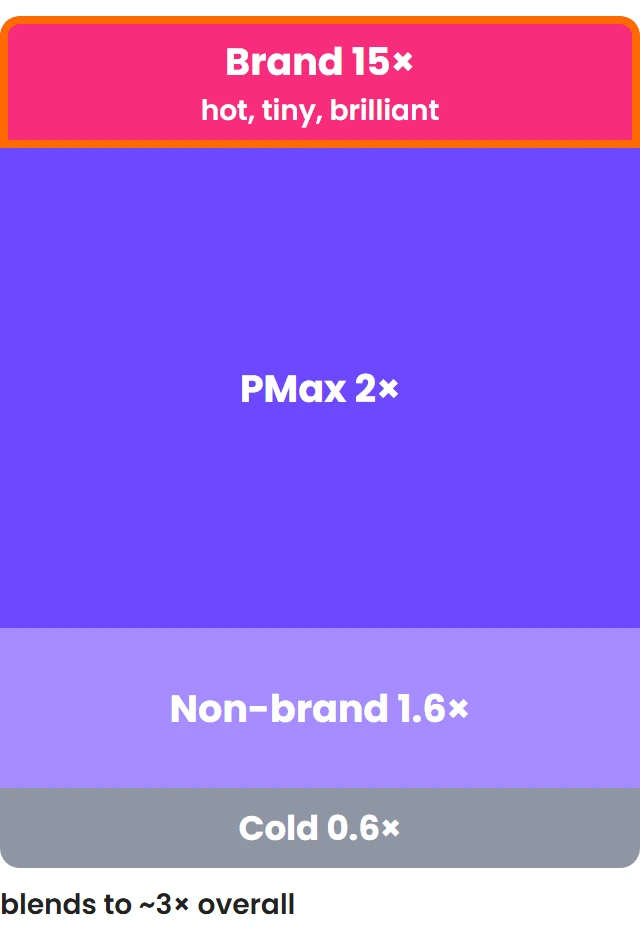
Here is one real account, split by Google campaign. Brand search returns 15 and cold campaigns 0.6, so the account blends to about 3:
The rule
Judge Meta and Google as one system. Cut or add a channel only after checking total sales, not that channel’s own number.
Step 1: check whether people search for you
Open Google Keyword Planner and look at your main product terms. If buyers already search for what you sell, Google Shopping is the first place to spend. It suits comparison products such as running shoes, appliances and mattresses, and higher-priced items where people research first.
Step 2: check whether you can create the want
Start with Meta if few people search for your product type, you have strong photos or video, or you are building a brand from nothing. New formats and niche products fit here.
Cold prospecting on Meta costs more per sale than retargeting or brand search. Check that your margin can carry that for a while.
Step 3: sequence it if the budget is small
Under £5,000 a month, this order is safer:
- Months 1 to 2: Google Shopping and brand search. Collect existing demand and learn your real conversion rate.
- Months 3 to 4: Meta retargeting to visitors, cart abandoners and past buyers.
- Month 5 on: Meta cold prospecting, with creative that has already worked.
A shop with strong margins and good creative can start Meta prospecting on day one, and accept a higher cost per sale early.
Step 4: split the budget once both run
For £15,000 to £30,000 a month, start with 55 to 65% on Meta (about 70/30 prospecting to retargeting) and 35 to 45% on Google, mostly Shopping and brand search. Above £50,000 a month, Google’s share often grows as brand search grows.
Related reading
- How much should you spend on Facebook Ads?
- Performance Max vs Standard Shopping: which is right?
- Platform ROAS is a lie
If Meta and Google are both claiming the same sale, book a free call and we’ll read it with you. Or see how our Google Ads and Meta ads teams plan the split.
Quick answers
Should I start with Meta Ads or Google Ads for ecommerce?
It depends on whether people already search for what you sell. If they do, start with Google Shopping. If nobody searches for your product type, start with Meta, because it can reach people who did not know they wanted it.
Can I run Meta Ads and Google Ads at the same time?
Yes, and most growing shops do. They do different jobs: Meta creates interest, Google collects it. Meta often lifts brand searches on Google, so cutting one can hurt the other.
Which is cheaper: Meta or Google Ads?
Neither always. Meta reach is often cheap, but conversion rates vary a lot by product and creative. Google clicks can cost more but convert better when the person is ready to buy. Compare cost per sale, not cost per click.
What budget do I need before Meta or Google Ads work?
As a guide, £1,500 to £3,000 a month for Meta and £1,000 to £2,000 for Google Shopping. Below that, the platforms see too few sales to learn from.